Loading...
Counter-UAS Shotgun Training System

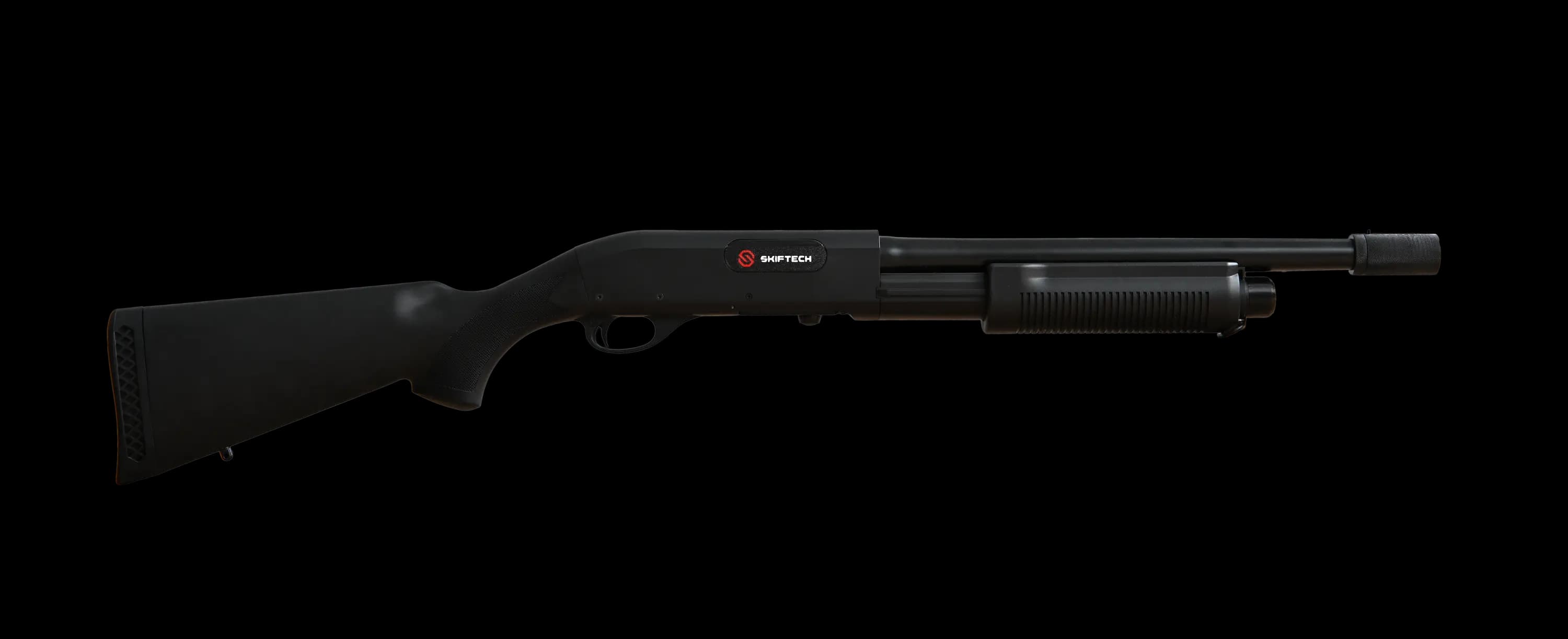
The Counter-UAS Shotgun Training System is designed to train military personnel in countering small unmanned aerial systems (UAS) using smoothbore shotguns in realistic buckshot engagement scenarios.
The system simulates engagement of real drones with an effective range of up to 55 meters, providing instant hit detection and performance analytics without the use of live ammunition.
Problem Statement
Modern units face a persistent threat from low-altitude small UAS, which are difficult to intercept without specialized training.
Conventional training is limited by the use of live ammunition, resulting in high operational costs, weapon wear, safety risks for personnel, and the absence of objective performance analytics when engaging moving aerial targets.
The Counter-UAS Shotgun Training System
transforms these challenges into advantages by enabling regular training in detection, tracking, and engagement of real drones in field conditions. It supports bidirectional scenarios (drone vs. unit) and provides full performance analytics via Military Statistics software.
SKIFTECH Ecosystem
The system integrates seamlessly with UAS simulators, KITS 3.0 soldier systems, drone payload modules, and Military Statistics software to enable comprehensive training scenarios (drone vs. infantry).
Target Users
The Counter-UAS Shotgun Training System is intended for training shooters and dedicated counter-UAS units to respond effectively to real battlefield threats.
Used by:
Shotgun operators
Counter-UAS units
Drone operators (for bidirectional scenarios)
Armed Forces and Defense training centers

Operating Principle
The system simulates shotgun fire using an IR pulse directed at real drones. Hits are detected by onboard sensors, and performance data is processed in Military Statistics software.
Step-by-step operation:
Instructor setup
The instructor configures the scenario in Military Statistics (selects drone type, ammunition type, altitude/speed, bidirectional mode), launches the drone, and initiates event recording.
Shooter preparation
Infantrymen equip KIT 3.0 (including sensors and Stress Belt), take the Remington M870 shotgun replica, and practice aiming and target tracking.
Training execution
The unit detects the drone, tracks it, and performs a simulated shot using an IR pulse. Drone-mounted sensors register hits.
Hit detection
Sensors detect the IR signal, accounting for distance and ammunition type. The Stress Belt delivers a safe feedback impulse if a soldier is hit in bidirectional scenarios.
Analytics and debriefing
The instructor tablet displays performance metrics, including accuracy, reaction time, drone flight paths, event logs, and KPIs. The instructor provides actionable feedback based on the results.

Key Features
Realistic weapon handling:
Remington M870 replica with authentic weight, balance, and pump-action mechanics
Real drone targets:
One-way UAS Training System, payload-drop drones, and Mavic-type UAVs at altitudes up to 55 m
Bidirectional scenarios:
Full-cycle training (drone vs. unit)
Instant analytics:
Real-time data capture in Military Statistics
Cost-efficiency and safety
No live ammunition, reduced weapon wear, safe group training
Full integration:
Compatible with KIT 3.0 and SKIFTECH drone payload systems
Technical Specifications
Parameter
Specifications
Type
Tagging device based on a Remington M870 pump-action shotgun replica (also compatible with semi-automatic platforms such as Hatsan BTS)
Operating principle
IR pulse emitted upon trigger pull and detected by target sensors
Effective range
Up to 55 m (realistic buckshot engagement distance)
Sensors
Mounted on drones/SKIFTECH payload modules; integrated with KIT 3.0 soldier system
Connectivity
Internal wired connections; wireless communication with tablet/software
Battery life
Up to 12 hours
Durability
Impact-resistant metal and polymer construction
Compatibility
SKIFTECH UAVs, Military Statistics software, KIT 3.0

Package Contents
Shotgun replica with IR module, trigger mechanism, and audio system
Charging device
Remote controller
Documentation (user manual, certificates)
The system is ready for field deployment and scalable for unit-level training.
Optional add-ons:
Drone-mounted sensor modules (hit detection units)
Instructor tablet with Military Statistics software
